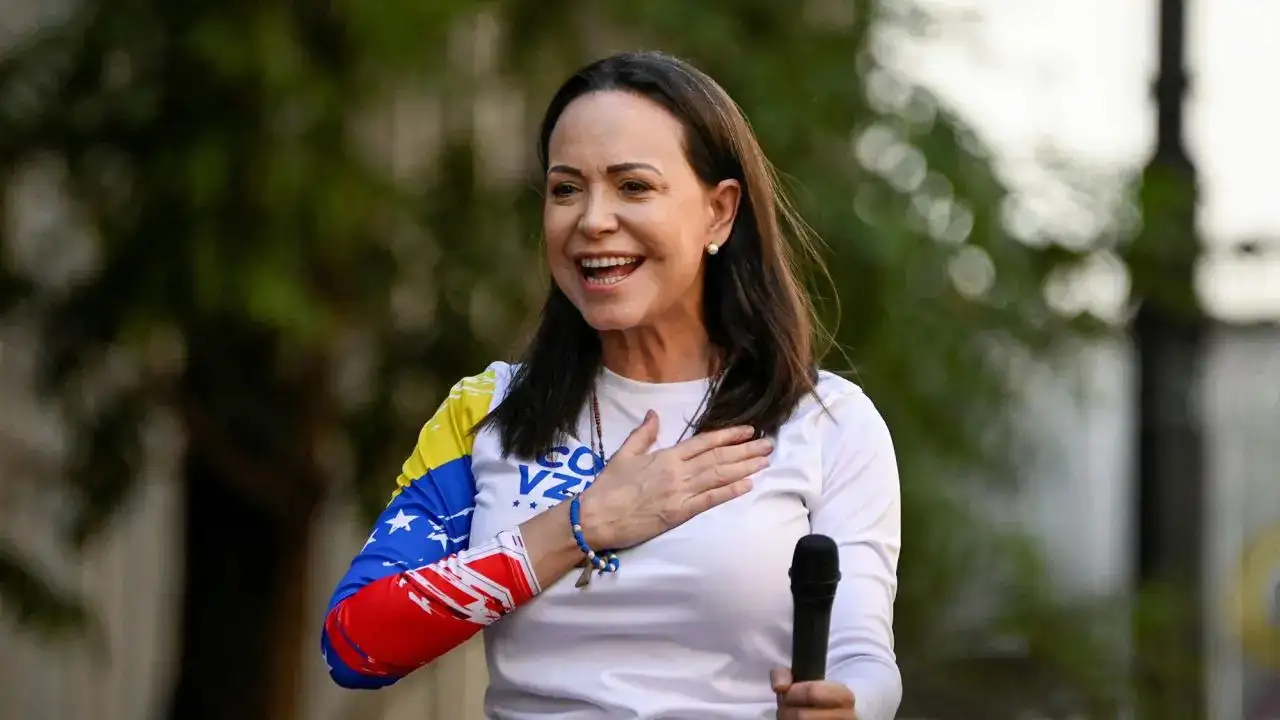
Emotional Machado says: "I am just one person. I certainly do not deserve this (Nobel Peace Prize). Oh my God!"
On October 10, 2025, the Norwegian Nobel Committee delivered a stunning rebuke to former U.S. President Donald J. Trump’s vocal campaign for the Nobel Peace Prize, instead honoring Venezuelan opposition leader María Corina Machado for her relentless fight to restore democracy in a nation gripped by authoritarian rule. The announcement, made in Oslo’s modest Nobel Institute, sent ripples across the globe, igniting debates from Washington to Caracas and underscoring the committee’s preference for quiet strength over flamboyant self-promotion.
The news was disclosed directly by Kristian Berg Harpviken, Director of the Norwegian Nobel Institute, just minutes before the official announcement in Oslo, as per the Nobel Prize organisation. The conversation went like this: “Hello? Am I talking to Maria Corina Machado?” Harpviken asked over the phone. When he told her that in a few minutes it would be announced that she would be awarded the Nobel Peace Prize for 2025, Machado reacted emotionally, saying, “Oh my God. Oh my God.”
Humbled and overwhelmed with emotion, she instantly diverted the spotlight toward her country: "Oh my God. Well, I have no words. Thank you so much, but I hope you understand this is a movement. This is an achievement of a whole society. I am just one person. I certainly do not deserve this. Oh my God."
Moments later after the news was revealed to the world, in an interview with Robyn E. Hardy, Assistant Research Manager at the Norwegian Nobel Institute, Machado said, “I accept this is as a recognition to our people, to the millions of Venezuelans that are anonymous and are risking everything they have for freedom, justice and peace and I’m absolutely convinced that we will achieve it.”
The Nobel Committee praised Machado and said that she was being awarded “for her tireless work promoting democratic rights for the people of Venezuela and for her struggle to achieve a just and peaceful transition from dictatorship to democracy," as per the Nobel Prize organisation.
Through this, a snub was heard across the world. US President Donald Trump, who had openly lobbied for the prize, citing his role in Middle East ceasefires, the ceasefire between India and Pakistan, and North Korean diplomacy, was reportedly incensed. Sources close to the former president described him pacing Mar-a-Lago, dictating fiery posts for Truth Social that labeled the decision “rigged” and the committee “a bunch of globalist hacks.” One post, timestamped 1:47 a.m., read: “Nobel Peace Prize goes to some lady hiding in Venezuela? Sad! I brought PEACE to the world—nobody does it better!” His supporters on X echoed the sentiment, trending hashtags like #TrumpNobel and #NobelFraud within hours.
But the committee, chaired by Jørgen Watne Frydnes, remained unmoved. In a press conference, Frydnes praised Machado’s “extraordinary courage in defending democratic rights and promoting a peaceful transition from dictatorship to democracy in Venezuela.”
The citation highlighted her decades-long struggle against the regimes of Hugo Chávez and Nicolás Maduro, emphasizing her role as a unifying force in a fractured nation. “When authoritarians silence dissent,” Frydnes said, “it is the steadfast who light the path to peace.”
Born on October 7, 1967, in Maracay, Venezuela, María Corina Machado grew up in a family of industrialists, her father a steel magnate and her mother a pillar of moral conviction. Educated in systems engineering at the Catholic University of America in Washington, D.C., she returned to Venezuela in the 1990s, initially carving out a career in industrial automation. But as Chávez’s Bolivarian Revolution tightened its grip, siphoning oil wealth into patronage and eroding democratic institutions, Machado pivoted to public life.
Her early rallies, delivered with a commanding presence, galvanized Venezuela’s middle class. “Democracy is not a gift- it is a responsibility,” she often declared, her words resonating in a country where voting machines were increasingly suspect. Súmate’s exposés of irregularities drew Chávez’s wrath; he branded Machado a “traitor” and accused her of conspiring with foreign powers.
Undeterred, Machado ran for the National Assembly in 2010, winning her district with a record-breaking 100,000-plus votes. Her tenure as a lawmaker was marked by fierce debates, where her sharp intellect dismantled regime talking points. But in 2014, the government stripped her of parliamentary immunity, alleging ties to a supposed assassination plot—a charge widely dismissed as fabricated. Expelled from office, she founded Vente Venezuela, a political movement that became a cornerstone of the opposition.
Machado’s leadership shone brightest in Venezuela’s darkest hours. As hyperinflation soared past 1,000,000% and millions fled the country, she united disparate opposition factions under the Soy Venezuela alliance in 2017. Her vision: a Venezuela where ballots, not bullets, would shape the future.
The Nobel Committee’s decision places Machado in rare company, joining the ranks of laureates who have challenged authoritarianism at great personal risk. The award, which includes a medal, a diploma, and approximately $1 million, is both a shield and a spotlight. Analysts suggest it may protect Machado from further persecution by raising the diplomatic cost of targeting her. “Maduro can’t touch her now without global backlash,” said Diego Arria, a former Venezuelan diplomat. “This is a game-changer.”

You Might Also Like