MEA Secretary Dammu Ravi says in his USTM Lecture, "The World is Rapidly Changing from Geopolitics to Geoeconomics"
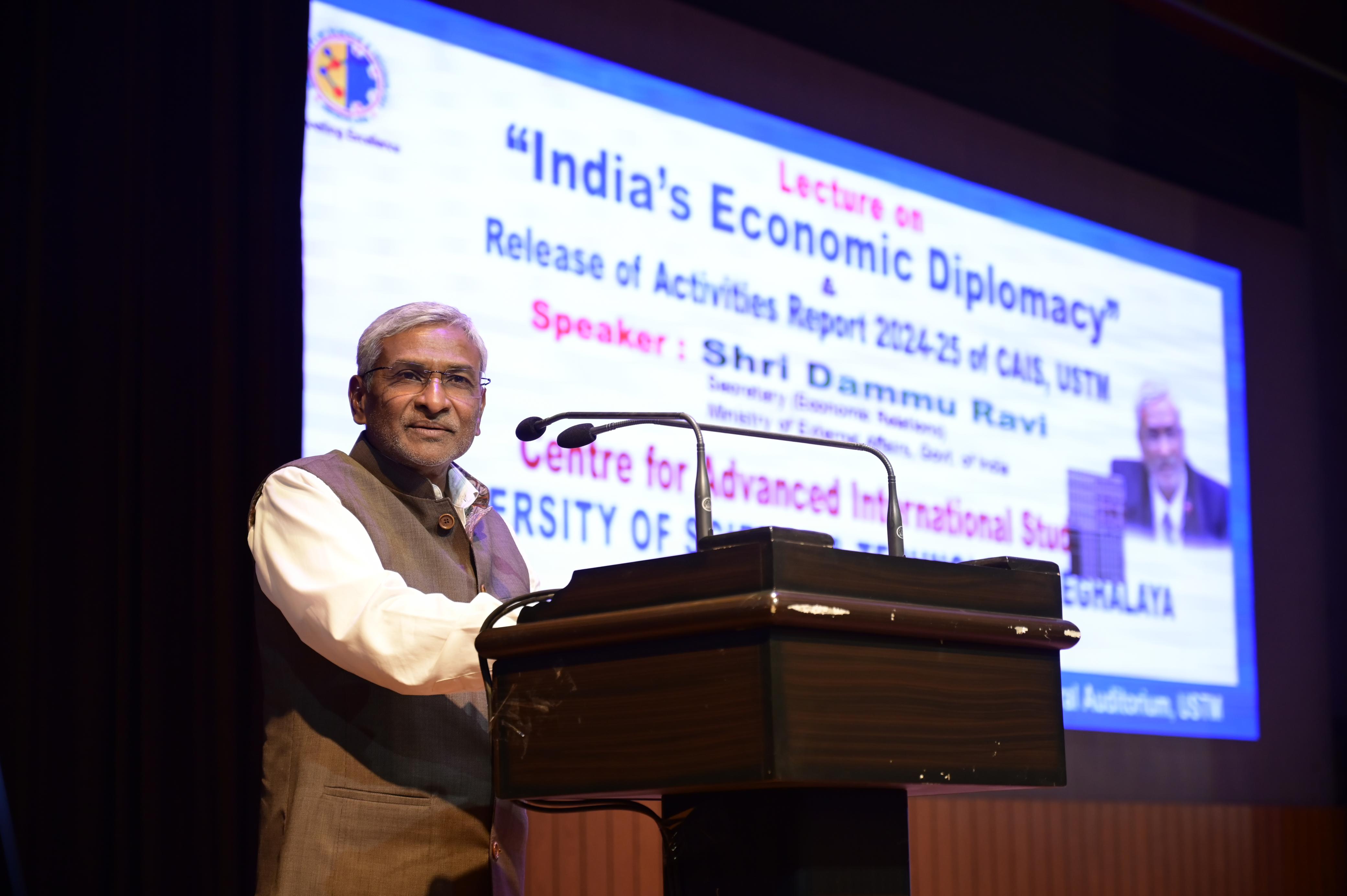
The University of Science and Technology Meghalaya (USTM) hosted an outstanding lecture on "India's Economic Diplomacy" by Shri Dammu Ravi, Secretary (Economic Relations) at the Ministry of External Affairs, Government of India. The occasion was chaired by Padma Shri Dr. Sarbeshwar Sahariya, Pro-Vice Chancellor of USTM.
The event commenced at the Central Auditorium of the USTM, where Padma Shri Dr. Sarbeshwar Sahariya, Pro Vice Chancellor of USTM, welcomed the gathering, highlighting the region's prominent presence on the world stage, particularly in North East India, and the crucial role of South East Asia in India's development.
Following this, Dr. Rejaul Karim Laskar, Director of the Centre for Advanced International Studies (CAIS) described all the collaborations of USTM with leading global universities.
The program proceeded with the formal release of the CAIS Activity Report 2024-2025, marking a significant milestone in the Centre's endeavours.
Shri Dammu Ravi, Secretary (Economic Relations) at the Ministry of External Affairs, Government of India, delivered a thought-provoking lecture in his calm, distinguished manner, shedding light on India's evolving economic diplomacy.
He pointed out the dynamic changes on the global stage and how dramatically the world is changing in the 21st century, stressing the change from geopolitics to geoeconomics, dominating with a greater weightage than geopolitics, set to influence every other relationship in the world.
He also spoke about the shifts in global power politics from Trans-Atlantic to Indo-Pacific due to several factors, as well as the surge in nationalization in the global arena, as not all countries are benefiting from globalization, He pointed out that while some people may think globalization has come to an end, it could not, according to him, because as long as technology is advancing, there will continue to be interdependence and closeness.
He said, "Across the world, the richer countries are becoming richer, and developing countries are even more vulnerable, which is why the idea of the Global South is so important."
During his address, he highlighted how technology is shaping lives, while adding efficiency, which will pose challenges such as job losses due to the displacement of humans by AI and fake news. Thus, the challenge is to integrate human values and principles with the all-expanding, ever-changing artificial world.
He said, "I am leaving a thought with you that the world is not only going to be unequal but challenging for future generations, which is why young people should be even more prepared with knowledge, information, ideals, and principles to face the 21st century.
He explained how supply chains are choked because of geopolitical tensions, and a new challenge that has arisen is the Trump Tariff, which also undermines the global rules that enable all countries to trade with one another with greater efficiency and mutual benefit, which is now undermined. A phase of authoritarianism taking a stronger expression on the global stage will have consequences, where "might is right" and "coercion over cooperation."
He raised the concern of the digital divide, where three billion people in the Global South of the world do not have Internet, which would leave them behind. Rising public debt is 102 trillion dollars, while it is 29 trillion dollars in the developing countries, which will hike their cost of living.
He closed with a bright note of motivation, expressing, "Interdependence creates a place for everyone to live in harmony."
Following his enlightening lecture, Shri Dammu Ravi took a couple of questions from the students.
The program concluded on a note of gratitude as Dr. Abhinandan Das, Principal of PA Sangma International Medical College, delivered a heartfelt vote of thanks.
Shri Dammu Ravi is a seasoned diplomat with over three decades of experience in the Indian Foreign Service. He has served in various capacities, including India's relations with Latin America and Caribbean countries, trade policy, and WTO issues. He was India's chief negotiator in the Regional Comprehensive Economic Partnership (RCEP) and has handled trade and investment relations with regional groups such as G20, BRICS, and SCO. His insightful discussion on India's economic diplomacy's impact on the global economy left an indelible mark on understanding the greater dynamics of India’s role in trade and wealth around the globe.