Exciting Discovery! NASA Reveals the Arrival of Strange Cosmic Objects from Interstellar Space
NASA has revealed thrilling new information about a mysterious interstellar object called 3I/ATLAS, speeding through our solar system at extraordinary velocities. First detected on July 1, this visitor from beyond our star system has intrigued scientists globally. The Hubble Space Telescope has caught the clearest images to date, offering key insights into its size, makeup, and path. These discoveries represent a significant advancement in our understanding of these rare travelers crossing the galaxy into our cosmic neighborhood.
Originating from the constellation Sagittarius, NASA’s Hubble Space Telescope observations have confirmed that 3I/ATLAS is travelling through our solar system at an extraordinary speed of 130,000 miles per hour (209,000 km/h), making it the fastest interstellar object ever recorded. This speed far exceeds that of previous interstellar visitors such as ‘Oumuamua and Borisov.
Scientists illustrate that the object’s velocity is the result of billions of years of gravitational interactions, known as the “gravitational slingshot effect,” where passing stars, planets, and nebulae impart additional momentum to the comet. This extreme speed means the object is only briefly visible as it races through, providing a fleeting window of opportunity for study.
Initial observations by the Vera C. Rubin Observatory indicated that 3I/ATLAS’s icy core might be around seven miles (11.2 km) wide. However, NASA’s Hubble Space Telescope has now updated these estimates, revealing that the core is smaller — at most 3.5 miles (5.6 km) across, and possibly as little as 1,000 feet (320 meters) in diameter. Despite being smaller than first believed, this still makes 3I/ATLAS the largest interstellar object ever discovered, dwarfing the next largest known visitor by up to 14 times. The high-resolution images also highlight the comet’s luminous gas halo, which had made it seem larger in earlier, less detailed observations. Understanding the true size helps scientists model its composition and behavior as it interacts with solar radiation.
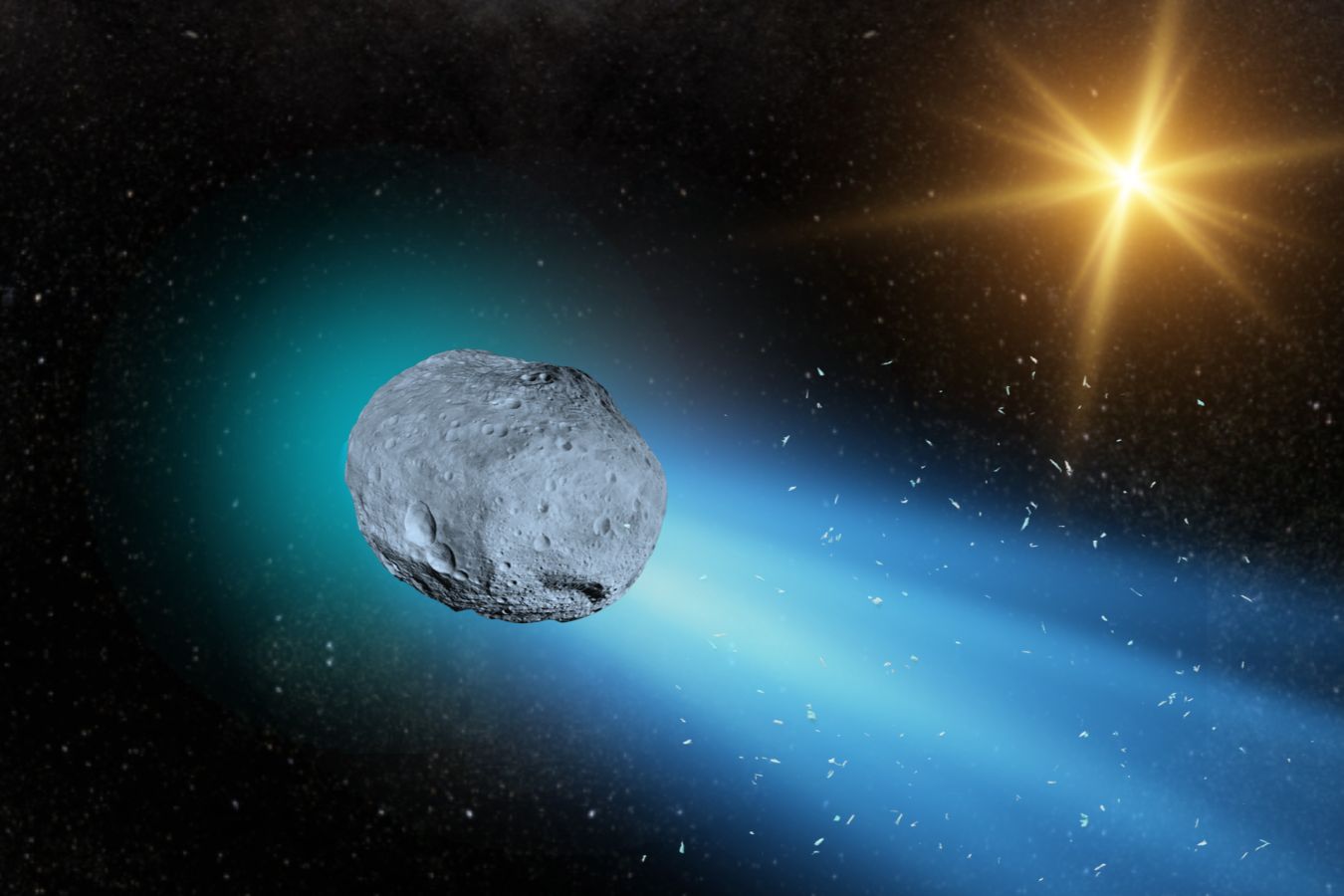
NASA’s powerful telescopes enabled scientists to confirm that 3I/ATLAS is not a solid rock but a comet — a chunk of ice, frozen gases, and dust surrounded by a halo of evaporating material. The Hubble images reveal a dust plume streaming from the side of the comet heated by the Sun, along with a faint tail trailing behind it. This tail is formed as the comet’s surface warms up, compelling ice to vaporize and discharge gas and dust into space, creating that particular halo around it.. This phenomenon is analogous to that seen in comets within our solar system, but 3I/ATLAS’s interstellar origin and extreme speed make it a rare and valuable subject for study. NASA expects the tail and dust plume to become more prominent as the object approaches its closest point to the Sun. Scientists hope continued observation will shed light on the comet’s chemical composition, helping uncover clues about its interstellar origins.
Despite its tremendous speed and proximity to the Sun, NASA has assured the public that 3I/ATLAS poses no threat to Earth. The comet will reach its closest point to the Sun in late October, passing just inside the orbit of Mars at about 130 million miles (210 million kilometers). Crucially, it will be on the opposite side of the Sun relative to Earth during this time, ensuring no risk of collision or gravitational disturbance. NASA continues to monitor the comet’s trajectory rigorously, as the interaction with the Sun’s heat may slightly alter its path. After passing the Sun, 3I/ATLAS will head back out into interstellar space, continuing its long journey through the galaxy. This may be humanity’s only chance to witness this antique wayfarer before it vanishes forever into the cosmic void. Its fleeting visit serves as a reminder of the vast, mysterious, and ever-changing nature of our universe.
Why does it matter:
According to scientists, objects such as 3I/ATLAS have marked their journey through space for billions of years. A comprehensive study on them will enable scientists to ascertain more about them and give clues about the material and conditions present in other star systems.
Studies will allow scientists to capture unprecedented data on the object's composition and exchange with the solar environment. These coordinated observations are paramount for building a more complete portrait of interstellar objects and their origins. This collaborative effort will deepen understanding of the design, source, and behavior of interstellar objects and their function in the cosmic ecosystem. Discovery also helps humankind to take precautions.