Professor Richard Robson Wins 2025 Nobel Prize in Chemistry
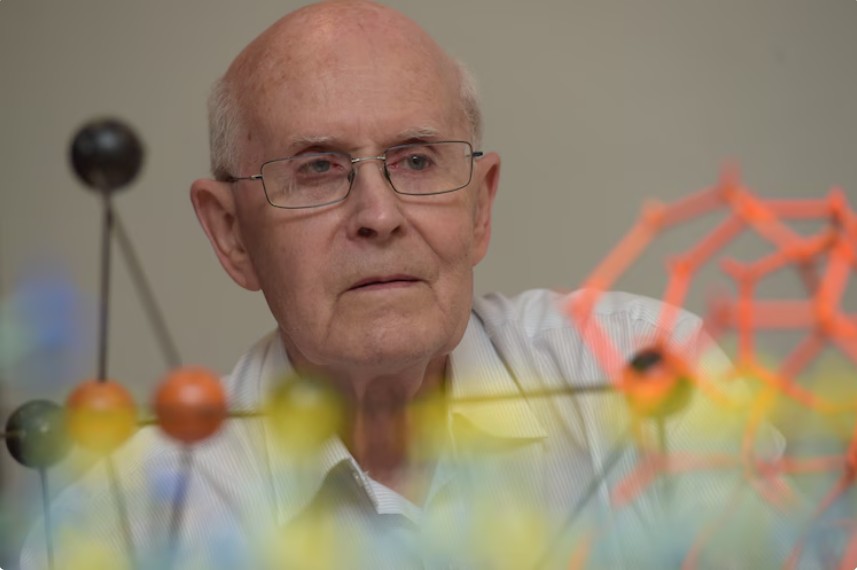
In a story that blends scientific brilliance with humble simplicity, Professor Richard Robson of the University of Melbourne has been awarded the 2025 Nobel Prize in Chemistry, sharing the honour with Professor Susumu Kitagawa of Japan and Professor Omar M. Yaghi of the United States. The trio was recognised “for the development of metal–organic frameworks (MOFs)” — an innovative class of materials built like microscopic scaffolds that can trap, store, or filter molecules with remarkable precision.
Speaking from his home, Professor Robson recalled the moment the Nobel Committee called: “I did finish my fish. It was a bit cold, but I got there. And then I had to do the washing up.” The domestic scene captures the modest rhythm of a life devoted to science.
From Classroom Models to Molecular Architecture
Professor Robson has been with the University of Melbourne since 1966. The seed of his Nobel-winning idea was planted in the 1970s, when he was building wooden molecular models for his chemistry lectures. “The thought arose, what if we used molecules in place of the balls and chemical bonds in place of the rods? And everything else follows from that,” he said.
That simple leap—from wooden spheres to molecular networks—led to the first crystalline structures with repeating cavities, reported in the late 1980s. These structures became the foundation of metal–organic frameworks, materials capable of performing complex chemical tasks in spaces invisible to the eye.
Turning an Idea Into a Global Field
Robson credits his collaborators, including Bernard Hoskins and Brendan Abrahams, for transforming his conceptual sketches into tangible, crystalline architectures. “I was just a hand waver. A sort of archetype,” he said, acknowledging the teamwork that made the breakthrough possible.
Soon after those first publications, Robson realised the potential of MOFs — a geometric toolkit for chemists. His early insight, expanded by Kitagawa and Yaghi, evolved into a new materials science frontier.
Science for a Sustainable Future
Today, MOFs are being explored for a range of environmental and industrial applications. They can capture carbon dioxide, extract water from air, remove pollutants from water, and even speed up chemical reactions in cleaner, more efficient ways.
Because of their modular design, scientists can fine-tune MOFs for specific purposes — from harvesting water in arid regions to trapping greenhouse gases. Kitagawa and Yaghi built on Robson’s work by making the frameworks more flexible, stable, and designable, paving the way for thousands of practical MOF variants.
A Lifetime of Discovery
Though long retired, Professor Robson’s pioneering ideas continue to shape modern chemistry. What began as a teaching aid has become a global effort to engineer materials that could address some of the planet’s most pressing challenges.
From a classroom in Melbourne to the Nobel stage in Stockholm, Robson’s journey is a testament to the quiet power of curiosity — and to the extraordinary science that can grow from an ordinary spark of imagination.

You Might Also Like