Anna Rajam Malhotra: India’s First Woman IAS Officer Who Broke Barriers with Grace
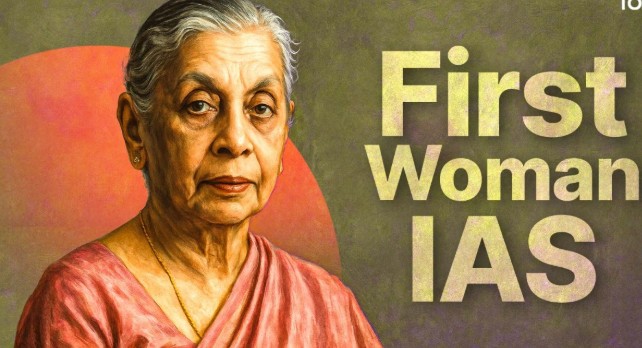
In 1951, when India was still shaping its democratic identity, a quiet yet historic moment took place in the corridors of the newly formed Indian Administrative Service (IAS). A young woman from Kerala, Anna Rajam Malhotra, became the first woman to join the IAS — breaking a gender barrier that had long stood unchallenged.
Born on July 17, 1927, in Niranam village of Pathanamthitta district, Kerala, Anna Rajam George grew up in an era when women were expected to remain behind the scenes. Defying convention, she pursued higher education, graduating from Malabar Christian College, Kozhikode, and later completing her Master’s degree in English Literature from the University of Madras.
When she decided to appear for the Civil Services Examination in 1950, many dismissed her ambition as unrealistic. The IAS was then considered an exclusive male domain, demanding not just intellect but also physical endurance and fieldwork. But Anna’s determination proved stronger than societal norms, and she successfully cleared the examination to make history.
The First Posting and Early Challenges
Anna Rajam was allotted the Madras cadre, with her first posting as Sub-Collector of Tirupattur in present-day Tamil Nadu. At a time when district administration involved difficult terrain, limited infrastructure, and no special facilities for women, she faced immense challenges.
Despite being the only woman officer in a male-dominated environment, she earned respect through her professionalism, discipline, and fairness. Her appointment letter even included a clause stating that her service would be terminated upon marriage — a reflection of the biases of the time.
Anna chose not to protest but to persevere. Years later, when she married her IAS batchmate R.N. Malhotra, who later became Governor of the Reserve Bank of India, the discriminatory clause had already been abolished — thanks to trailblazers like her.
A Distinguished Career in Nation-Building
Over the next four decades, Anna Rajam Malhotra served with distinction in various capacities across departments such as Revenue, Agriculture, Education, Culture, and Transport. She worked closely with some of India’s most respected leaders, including C. Rajagopalachari, Indira Gandhi, and Rajiv Gandhi.
Her most notable contribution came as the Chairperson of the Jawaharlal Nehru Port Trust (JNPT) in Mumbai. Under her leadership, JNPT emerged as India’s largest and most efficient port, a model of modernisation and effective governance.
In recognition of her exemplary service, she was conferred the Padma Bhushan in 1989.
A Legacy of Grace and Grit
Even though Anna Rajam Malhotra broke one of India’s most rigid glass ceilings, she never considered herself a symbol of women’s empowerment. She often said she only wanted to do her job with sincerity and excellence. Yet, her journey became a powerful message for generations of women who followed.
She retired in 1996 after an illustrious career and passed away in 2018 at the age of 91. Today, hundreds of women serve in the Indian Administrative Service — walking through the door she first opened in 1951.
Anna Rajam Malhotra’s life remains a testament to quiet courage and enduring conviction. She proved that true change doesn’t always come through protests or speeches — sometimes, it comes through the unwavering dedication of one woman who refused to accept limits.

You Might Also Like